


Digital Transformation in Healthcare
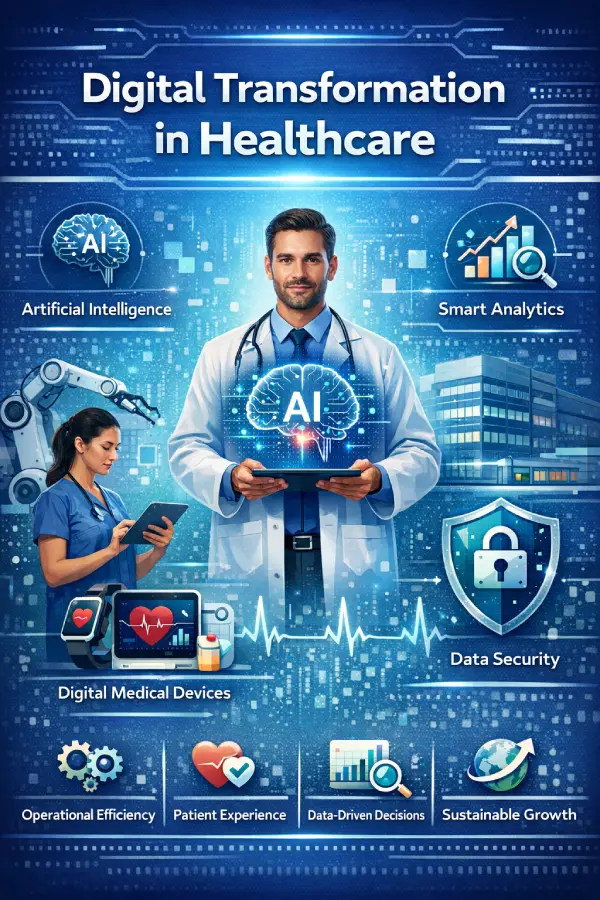
One of the biggest changes in the history of the healthcare sector is currently taking place. Traditional healthcare models are no longer viable due to increased patient expectations, operational complexity, regulatory pressure, and expanding competition. Healthcare digital transformation, a strategic movement that transforms how healthcare organizations function, provide treatment, and attain long-term sustainability, lies at the core of this evolution.
With the help of cutting-edge health IT, digital transformation is now a need rather than a goal for the future. Healthcare networks, clinics, and hospitals that accept this shift are becoming more resilient, visible, and efficient, while those that don’t are finding it difficult to keep up.
Digital Transformation in Healthcare: What Is It?
The use of digital technologies in all facets of healthcare operations to enhance productivity, patient outcomes, decision-making, and financial performance is known as “healthcare digital transformation.” It is far more than just adopting isolated tools or digitizing records.
Rethinking workflows, automating procedures, linking data across departments, and allowing real-time insights that support proactive treatment and more intelligent management are all necessary components of true healthcare digital transformation. Modern health IT systems that combine clinical, operational, and financial data into a single intelligent ecosystem enable this change.
Why Digital Transformation in Healthcare Is No Longer Optional
The challenges facing healthcare providers today are unprecedented. Demands for speed and convenience are greater than ever, patient volumes are growing, and expenses are rising as well. Organizations suffer from inefficiencies, data silos, and delayed decision-making in the absence of digital transformation in healthcare.
Healthcare providers may streamline processes, lower errors, and create more individualized patient experiences with the help of advanced health IT systems. Clinics that put off implementing digital technology frequently end up being overburdened by manual procedures and unable to grow efficiently.
The Function of Health IT in Contemporary Medical Care
Health IT is the cornerstone of the digital transformation of healthcare. Electronic medical records, clinic management systems, CRM platforms, analytics tools, automation engines, and secure communication routes are some examples of these technologies.
Data flows smoothly throughout the company because of modern health IT systems that link every function, including front desk, clinical staff, finance, labs, and marketing. This linkage creates a coherent, data-driven paradigm from disjointed operations.
Digital transformation initiatives remain unfinished and ineffectual in the absence of robust health IT.
Enhancing Operational Effectiveness via Digital Revolution
One of the main causes of healthcare costs is operational inefficiency. Workflows are slowed down and error risk is increased by manual scheduling, paper records, and disconnected systems.
Clinics automate inventory management, billing, scheduling, and reporting through healthcare digital transformation. By reducing administrative stress, smart health IT platforms free up staff members to concentrate on patient care instead of paperwork.
Automation increases precision and consistency in day-to-day processes while also saving time.
Learn more about advanced healthcare management systems and how they help clinics unify clinical, financial, and operational processes within one integrated platform.
Enhancing Patient Experience in the Digital Era
Patient experience has become a key differentiator in healthcare. Long wait times, unclear communication, and delayed follow-ups negatively impact satisfaction and retention.
Healthcare digital transformation enables clinics to offer faster booking, automated reminders, digital check-ins, and clear communication. With integrated health IT, patients receive timely updates, personalized messages, and transparent billing information.
This shift creates a more patient-centric healthcare experience built on convenience and trust.
Making Decisions Based on Data
Large volumes of data are produced by the healthcare industry, but they are underutilized in the absence of appropriate tools. Converting unprocessed data into useful insights is one of the most potent advantages of healthcare digital transformation.
Predictive analytics, performance measurements, and real-time dashboards are all offered by sophisticated health IT platforms. Clinics have rapid access to data on patient behavior, physician performance, revenue trends, and operational obstacles.
Leaders make well-informed decisions supported by precise data rather than depending on conjecture.
Revenue Control and Financial Transparency
In conventional healthcare operations, financial leakage is a frequent problem. Profitability is decreased by manual invoicing, postponed reporting, and inadequate cost awareness.
Financial data is now accessible and open thanks to the digital transformation of healthcare. Real-time tracking of income, costs, physician commissions, and inventory consumption is possible with integrated health IT systems.
Healthcare companies are able to optimize pricing, minimize costs, and increase total profitability because of this financial transparency.
Workforce Productivity and Digital Transformation
Healthcare workers are always under pressure. Time that could be spent with patients is wasted on administrative duties.
Healthcare digital transformation improves workflows, streamlines communication, and automates repetitive tasks. Contemporary health IT systems lessen burnout by streamlining daily tasks and enhancing team coordination.
A workforce that has access to digital tools is more engaged, productive, and content.
Scalability and Technological Development
Unstructured growth results in anarchy. Managing operations by hand becomes very impossible as clinics grow into several departments or specialties.
Scalability is made possible by healthcare digital transformation, which centralizes data and standardizes procedures. Consistent patient experiences across sites, unified reporting, and multi-branch operations are all supported by strong health IT platforms.
Growth is managed, sustainable, and quantifiable thanks to technology.
Trust, Security, and Compliance
Data in healthcare is extremely sensitive and subject to strict regulations. Manual systems raise the possibility of non-compliance, data loss, and breaches.
Security and compliance are key to the architecture of contemporary health IT solutions. Secure backups, audit trails, role-based access, and encryption all help with the digital revolution of healthcare while safeguarding patient privacy.
Technology that protects financial and clinical data fosters trust.
The Benefits of Early Adoption Strategically
Businesses who make early investments in the digital revolution of healthcare are at a competitive advantage. They consistently improve performance, adjust to patient expectations, and react more quickly to changes in the market.
Healthcare providers may innovate, embrace AI-driven insights, and get ready for next developments like tailored treatment pathways and predictive care when they have a robust health IT infrastructure.
In a healthcare ecosystem that is becoming more and more digital, those who put off adoption run the danger of falling behind.
The Digital Transformation of Healthcare in the Future
Healthcare will be sophisticated, networked, and data-driven in the future. Predictive analytics, automation, and artificial intelligence will all play a bigger part in the ongoing digital revolution of healthcare.
Beyond reporting, advanced health IT systems will forecast, assisting clinics in anticipating patient demands, maximizing resources, and averting problems before they arise.
Digital transformation is a continuous process rather than a one-time event.
Conclusion
Healthcare is no longer driven by intuition alone. Success today depends on insight, efficiency, and adaptability. Healthcare digital transformation empowers organizations to modernize operations, enhance patient experiences, and achieve sustainable growth.
Supported by powerful health IT, digital transformation connects people, processes, and data into one cohesive system. Clinics and healthcare organizations that embrace this shift are not just surviving, they are leading the future of care.
The message is clear, the future of healthcare belongs to those who transform digitally, strategically, and intelligently.
